

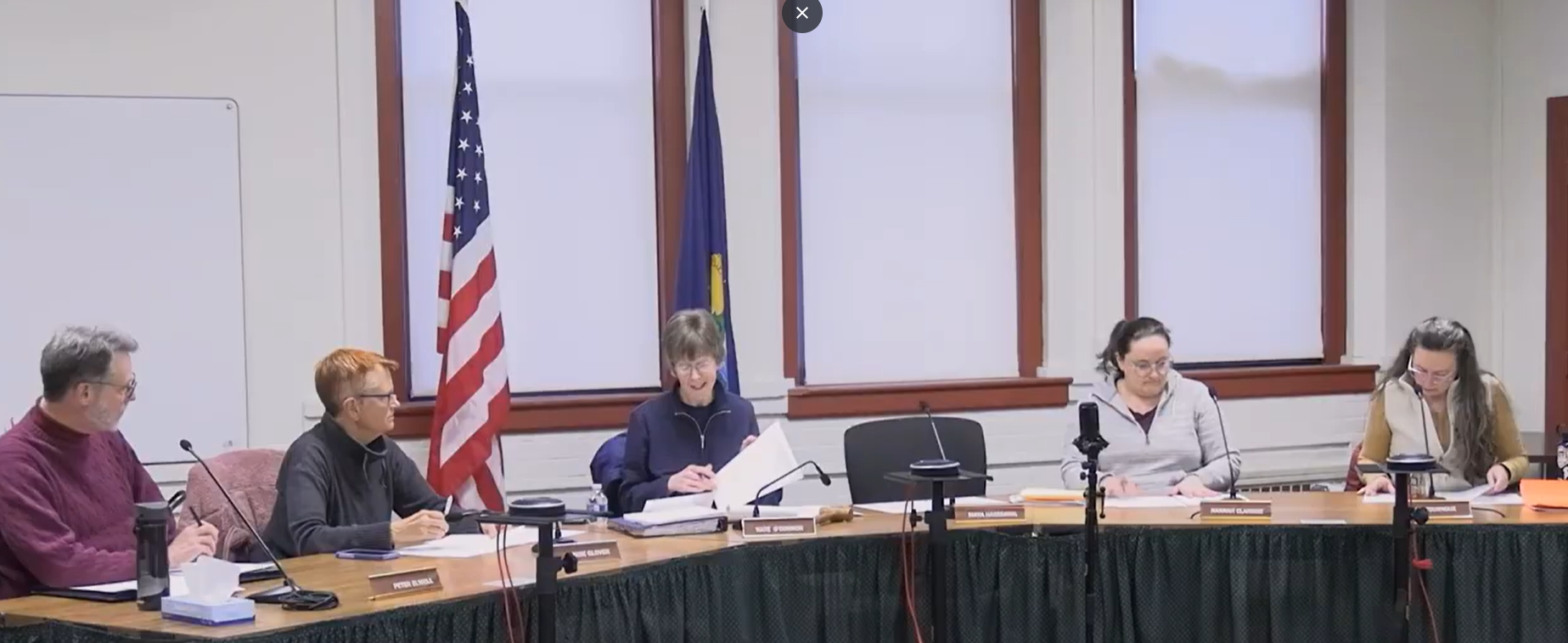
BRATTLEBORO — After nearly four years of work, 50 public meetings and a year of debate over the future of local democracy, Brattleboro's Charter Revision Commission is preparing to bring its proposed rewrite of the town charter to the public.
The commission will hold an informational meeting Wednesday, December 2, from 6 to 8 p.m. in the Main Reading Room at Brooks Memorial Library, 224 Main Street. Commission members will explain their recommended changes, discuss the reasoning behind them and answer questions from residents.
The meeting marks the first opportunity for the public to hear the proposed revisions in their entirety, according to a November 20 announcement from the town. The meeting will be recorded by Brattleboro Community Television and posted on its YouTube channel. There will be no live Zoom option.
The proposed charter changes are scheduled to go before Brattleboro voters on March 2, 2027.
But the document being presented is about more than updating an old municipal charter. It reflects a fundamental change in how Brattleboro residents want to govern themselves — and an effort to reconcile two different visions of local democracy that emerged from this year's Town Meeting Day election.
A government structure dating back to 1959
Brattleboro has a distinctive history of municipal government.
The town's original charter dates to 1753, when it was established under a grant from Benning Wentworth, governor of the Royal Colony of New Hampshire. A new charter adopted in 1927 merged the town and village governments. A comprehensive revision followed in 1984.
But perhaps the most consequential change came in 1959, when the Vermont Legislature authorized Brattleboro to establish Representative Town Meeting.
Under that system, residents elected representatives from different districts to make decisions on behalf of the town's voters. Instead of every registered voter attending and voting on the municipal budget and other town business, an elected group of representatives conducted much of that work.
Brattleboro became the only Vermont town to use this form of government.
The arrangement remained in place for more than six decades, although the charter was amended several times, including in 2012, 2013, 2016 and 2023.
Over time, however, questions about representation, accessibility and the effectiveness of Representative Town Meeting became increasingly prominent.
In a March 2025 public forum, the Charter Revision Commission began a broader discussion about whether Brattleboro should retain its representative system, modify it or return to the more traditional open Town Meeting format used by most Vermont communities.
The commission's work was initially intended to produce a set of recommendations that could be considered in 2025 and then move through the state approval process.
Events in 2026 changed that timetable.
Voters deliver two messages
On March 3, 2026, Brattleboro voters approved two citizen petitions that would eliminate Representative Town Meeting.
One called for replacing it with Open Town Meeting, where all registered voters can participate directly in town decisions.
The other called for replacing the representative system with Australian ballot voting, allowing residents to cast private ballots on town business, including budget questions.
Both proposals passed, creating a challenge for the Charter Revision Commission: How could the town honor both decisions?
The underlying vote to discontinue Representative Town Meeting was relatively close, with 1,216 voters supporting its elimination and 1,157 opposing it, according to reporting by The Commons.
The two successful petitions also raised questions about how open discussion and townwide voting might work together.
In May, the commission reconvened to address the issue. Chair Kate O'Connor expressed concern that if Brattleboro could not develop a proposal in time, the Legislature might ultimately determine the town's options.
Commission members and residents discussed the possibility of combining an in-person town meeting with an automatic townwide vote on the municipal budget.
That approach became central to the commission's recommendations.
A hybrid approach to Town Meeting
Under the proposed revisions, Brattleboro would hold an in-person Open Town Meeting in January, allowing registered voters to participate directly in discussion and decision-making.
The town budget would then go to voters through an automatic Australian ballot vote in March.
The proposal is intended to preserve the opportunity for residents to debate town issues in person while ensuring that everyone eligible to vote has an opportunity to weigh in on the budget, whether or not they can attend a meeting.
According to the commission's recommendations, this combined approach would be a first for Vermont.
The proposal also addresses what happens to two important committees that were associated with Representative Town Meeting.
The Finance Committee and Human Services Committee would be reestablished, with members elected directly by voters at the March election. The draft specifies their membership, terms and responsibilities.
The commission has also added provisions addressing how human services funding should be allocated.
Other proposed changes would remove outdated language and reorganize the charter into nine articles. References to Representative Town Meeting and the 1959 legislation establishing it would be eliminated. Provisions concerning school directors that no longer apply would also be removed.
The commission proposes eliminating the Capital Grants Review Board, which has never met, and revising how the charter describes town government and its various responsibilities.
The goal, according to the commission, is to create a document that more accurately reflects how Brattleboro operates today and is easier for residents to understand.
Four years of work
The Selectboard appointed the Charter Revision Commission in December 2022. Its work began in January 2023.
The commission originally had seven members, although two members subsequently resigned. The five members currently serving are Chair Kate O'Connor, Vice Chair Maya Hasegawa, Clerk Joy Tournoux, Peter Elwell and Denise Glover.
Over the course of its work, the commission held 50 public meetings between January 2023 and September 2026.
Members reviewed previous versions of Brattleboro's charter, consulted town officials and department heads, sought input from residents and examined all 102 municipal charters approved by the Vermont Legislature.
The commission also consulted the town attorney and reviewed the history of Representative Town Meeting and other forms of municipal government.
The resulting September 2026 draft represents an extensive effort to address both the town's existing governmental structure and the changes voters have requested.
The commission presented its recommendations to the Selectboard in October.
What happens next?
The December 2 meeting is an opportunity for residents to examine the proposed changes before the March vote.
A second public meeting, required as part of the charter revision process, will be held by the Selectboard on Wednesday, December 16, at 6:15 p.m., also in the Main Reading Room at Brooks Memorial Library. That meeting will provide another opportunity for public comment.
Ultimately, Brattleboro voters will decide whether to approve the proposed charter revisions on March 2, 2027.
Even if voters approve the changes, the process will not end there. Charter amendments must also be forwarded to the Vermont Legislature for approval and then to the governor for signature.
For a town that has operated under Representative Town Meeting since 1959, the coming months could mark the beginning of a substantially different chapter in local government.
The December 2 meeting offers residents an opportunity to see what that future might look like — and to ask questions before they are asked to vote on it.
Meeting details: Wednesday, December 2, 6–8 p.m., Main Reading Room, Brooks Memorial Library, 224 Main Street, Brattleboro. The meeting will be recorded by BCTV; no Zoom participation will be available.
 Brooks Memorial Library access to be restricted Nov. 20–25 during parking lot repaving
 Months-long manhunt ends with arrest of convicted sex offender in Windham County
 Three injured in response to Linden Street apartment blaze
 Brattleboro Announces Thanksgiving Closures, Free Holiday Parking and Expanded Recreation Hours
 Keene Begins $1.4 Million Cemetery Expansion Monday, Funded Through Decades of Burial Plot Sales