

KEENE, N.H. — The Keene City Council has approved two new ordinances regulating short-term rentals, introducing additional requirements for property owners who earn income through platforms like Airbnb and Vrbo, while raising questions about how government oversight could affect tourism, housing costs, and the local economy.
The ordinances, approved Thursday, November 19, by votes of 11-3 and 13-1, establish standards for properties rented to visitors for fewer than 30 days.
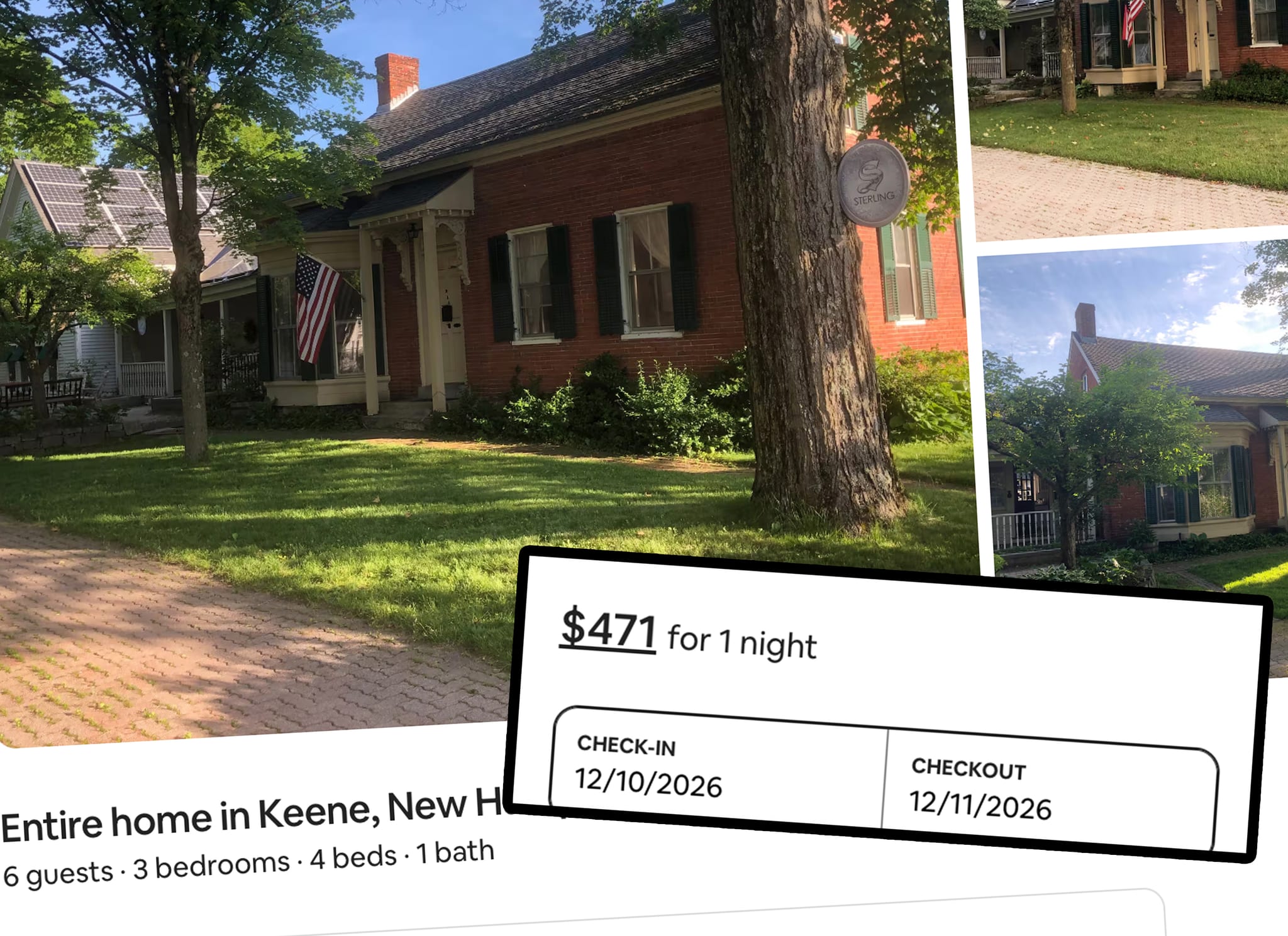
The decision comes as short-term rentals continue to offer an alternative to traditional hotels, with properties ranging from modest private apartments to entire three-bedroom homes capable of accommodating families and larger groups.
While city officials say the regulations are intended to protect residential neighborhoods, the issue highlights a broader debate over private property rights, homeowners' opportunities to generate income, and whether additional regulations could eventually reduce lodging options for visitors.
From Historic Downtown Apartments to Family Vacation Homes
A review of Airbnb listings in Keene reveals a range of accommodations appealing to tourists who might prefer something different from a traditional hotel room.
Among them is "Up Top" at Ro & Oak House, a two-bedroom downtown apartment advertised as being within a three-minute walk of Central Square. The property features a rooftop deck, soaking tub, kitchen, and free parking.
In the same historic building, "Midtown" at Ro & Oak House offers another two-bedroom apartment accommodating up to four guests, with a sun porch, full kitchen, and walking access to downtown restaurants and shops.
For larger families, "Cozy Downtown Getaway!" offers an entire three-bedroom house accommodating up to eight guests. The property includes a private backyard, fire pit, outdoor grill, and allows pets.
Another listing, "Family-Friendly 3BR Historic Home", advertises a renovated 1920s house accommodating six guests. The property features a chef's kitchen, fireplace, fenced backyard, and outdoor entertaining space.
According to its listing, guests can walk to Ashuelot River Park in approximately five minutes and reach downtown restaurants and shops in about ten minutes.
Smaller accommodations are also available. "Cozy Retreat Near Downtown" offers a private one-bedroom unit within walking distance of Central Square. The property's hosts live in the home below the rental unit.
Together, the listings illustrate the variety of lodging choices available to travelers visiting the Monadnock Region, from private apartments for couples to entire houses designed for family vacations.
Several hosts specifically promote Keene's restaurants, cafés, shops, and attractions as reasons to book their properties.
How Do Airbnb Prices Compare With Keene Hotels?
Short-term rentals also compete directly with traditional hotels for visitors' lodging dollars.
According to pricing information published on Airbnb's Keene-area vacation rental pages, accommodations are advertised starting at approximately $50 per night before taxes and fees.
Airbnb's published pricing guide shows average January nightly prices of approximately $134 for vacation rentals overall, $140 for apartments, and $183 for houses. Those figures cover the platform's broader Keene-area listings rather than specific individual properties.
However, a separate analysis by the vacation rental research company AirDNA suggests that actual booked rates can be considerably higher.
In data updated in November 2026, AirDNA reported that short-term rentals in its Keene market averaged approximately $222 per booked night during the preceding 12 months.
The company also estimated average annual revenue of approximately $35,100 per active listing, before property-related expenses. That figure represents rental revenue, not homeowner profit.
By comparison, advertised starting prices for traditional hotel rooms in Keene reviewed on Booking.com ranged from approximately $132 to $194 per night.
The Keene Elm City Hotel advertised rooms starting at $132 per night, while the Best Western Plus Keene Hotel showed rates beginning at $149.
The Hampton Inn & Suites Keene advertised rooms beginning at $174.60, Courtyard Keene Downtown at $189.05, and the Fairfield Inn & Suites by Marriott Keene Downtown at $193.80.
The hotel prices are advertised starting rates, not confirmed bookings for the same dates as the Airbnb examples. Actual prices vary depending on availability, travel dates, and accommodations.
While some short-term rentals may cost more than a single hotel room, the comparison becomes different for larger groups.
A family requiring two or three hotel rooms could face a substantially higher total bill than a group sharing an entire house, depending on the property's rental rate and additional fees.
For example, two hotel rooms costing $175 each would total $350 per night before taxes. A three-bedroom vacation rental could offer substantially more space, a private kitchen, and shared living areas under one reservation, although the final cost depends on the individual listing.
Short-term rentals can also offer amenities not typically available in a standard hotel room, such as full kitchens, private outdoor spaces, laundry facilities, and accommodations for pets.
However, Airbnb reservations may include cleaning fees and booking-related charges that increase the final price, while hotels may offer amenities such as complimentary breakfast, daily housekeeping, and other services.
For visitors deciding between the two, the total price and type of accommodations can be just as important as the advertised nightly rate.
Airbnb Guests Pay the Same State Rooms Tax as Hotel Guests
Despite differences in their business models, short-term rentals in New Hampshire are subject to the same state Meals and Rooms Tax rate as traditional hotels.
Under New Hampshire law, an 8.5 percent tax applies to taxable lodging accommodations, including stays booked through Airbnb and Vrbo.
Airbnb states that it collects and remits New Hampshire's 8.5 percent Meals and Rooms Tax on qualifying reservations, including applicable cleaning fees and guest service fees.
For example, a $200 taxable nightly accommodation charge would generate $17 in state rooms tax, bringing the total to $217 before any additional fees.
The state tax is paid by the guest, rather than imposed directly on the homeowner's earnings, although operators remain responsible for complying with applicable tax laws.
New Hampshire also requires short-term rental operators to obtain a Meals and Rooms Tax license, and state law requires rental advertisements to display the operator's license number.
The state defines a short-term rental for these tax and advertising purposes as an accommodation rented for fewer than 185 consecutive days, a broader period than Keene's new municipal definition of fewer than 30 days.
That distinction is important because short-term rentals are not exempt from the taxes that apply to hotel accommodations simply because they are operated by private homeowners.
The tax revenue generated by those stays is collected by the state, meaning both traditional hotels and short-term rental accommodations contribute to New Hampshire's lodging tax revenues.
What Keene's New Ordinances Require
Under Ordinance O-2026-09-A, short-term rentals are formally permitted in 15 zoning districts throughout Keene, including residential neighborhoods, downtown areas, and certain commercial districts.
The ordinance distinguishes between hosted rentals, where the property is the owner's or lessee's primary residence, and non-hosted rentals, where it is not.
Short-term rental properties within residential zoning districts must maintain their residential appearance.
Non-hosted rentals must also post emergency contact information identifying the property owner or an authorized representative.
If the owner or representative lives more than an hour away, information for a person within an hour's drive who can address emergencies must also be provided.
For property owners living outside the region, that requirement could mean arranging for someone locally to respond to emergencies, potentially adding another responsibility or expense.
The city has not adopted a separate short-term rental licensing program, annual registration fee, or limit on the number of nights a property can be rented.
In fact, the ordinances also formally recognize short-term rentals as permitted uses within numerous zoning districts.
Nevertheless, they establish operating standards that could become the foundation for additional regulations.
Tourism Benefits Versus Housing Concerns
The economic benefits of short-term rentals were reflected in a city-sponsored survey conducted earlier this year.
Of the 267 respondents who answered a question about potential benefits, 115 — approximately 43 percent — identified increased spending at local businesses as an important advantage.
Another 93 identified better lodging options for families, visitors with pets, and other travelers, while 82 pointed to the possibility of making homeownership more affordable through additional income.
The results suggest that at least some residents recognize the relationship between short-term rentals, local tourism, and homeowners' finances.
Those benefits could be particularly relevant in a region attracting visitors for festivals, outdoor recreation, college events, family gatherings, and other activities.
Visitors staying in privately owned homes may spend money at downtown restaurants, independently owned businesses, grocery stores, and other establishments.
Meanwhile, rental income can help homeowners offset mortgage payments, property taxes, insurance, maintenance, and other expenses.
However, some city councilors have expressed concerns that allowing houses and apartments to operate as short-term rentals could remove properties from the long-term housing market, potentially worsening Keene's existing housing shortage.
During Thursday's discussion, councilors referenced an estimated 80 short-term rentals operating among approximately 10,000 housing units in Keene.
Private industry estimates differ. AirDNA reports a substantially higher number of active listings in its Keene market, although its data collection methods and definition of active listings differ from the city's estimates, making direct comparisons difficult.
City officials have previously reported relatively few complaints involving short-term rentals compared with traditional long-term rental properties.
That leaves policymakers weighing the potential benefits of rental income and visitor spending against concerns about housing availability and neighborhood conditions.
Other Cities Have Taken More Restrictive Approaches
Keene's new rules remain relatively limited compared with restrictions adopted elsewhere.
In Burlington, Vermont, short-term rental operators face registration requirements and restrictions on which properties qualify.
The city charges an annual registration fee of $220 for an entire short-term rental unit.
In Portsmouth, New Hampshire, regulations have historically prevented many short-term rental operations in residential neighborhoods.
In 2019, the New Hampshire Supreme Court upheld Portsmouth's authority to prohibit short-term rental use of a house in a residential zoning district.
The case involved property owners who renovated a four-bedroom house with the intention of renting it to visitors through platforms such as Airbnb.
The court determined that the operation constituted transient lodging rather than a permitted residential use under Portsmouth's zoning ordinance.
Perhaps the most dramatic example comes from New York City, which began enforcing stringent short-term rental registration requirements in September 2023.
The regulations largely prevent owners from renting entire apartments or houses to tourists for fewer than 30 days without a permanent occupant present.
The changes have produced measurable financial consequences for the hotel industry.
A study published in the European Journal of Political Economy in September 2025 found that New York City's short-term rental restrictions increased average hotel room rates by approximately $14 to $19 per night.
Researchers estimated that the restrictions generated an additional $2.1 billion to $2.9 billion in hotel revenue over their first 18 months.
The study provides evidence that limiting competition from short-term rentals can benefit traditional hotels while increasing lodging costs for visitors.
New York City officials have defended their regulations as necessary to protect residential housing from conversion to tourist accommodations.
Keene's regulations are substantially less restrictive, and the economic effects documented in New York City cannot be assumed to occur locally.
Could More Restrictions Be Coming?
While Keene's newly approved ordinances allow short-term rentals to continue operating, city officials have indicated that additional regulations could be considered.
Planning staff intend to monitor short-term rental activity over the next one to three years, tracking the number of properties operating and any complaints associated with them.
If officials identify emerging problems, additional rules could be brought before the City Council.
For property owners, that leaves uncertainty about whether future requirements could affect their ability to generate income from their homes.
For the tourism industry, the larger question is whether additional restrictions could eventually reduce the variety of accommodations available to visitors who prefer private homes over traditional hotels.
And for local businesses, the potential impact extends beyond the rental properties themselves.
Whether guests spend $150 or $250 a night on accommodations, those visitors also represent potential customers for Keene's restaurants, shops, and attractions.
For now, Keene's regulations stop short of the restrictions adopted in several other cities.
Whether the city maintains that approach will depend on how its short-term rental market develops — and how officials balance neighborhood concerns, housing availability, property rights, and the economic benefits of welcoming visitors to the Monadnock Region.
 Two Vehicles Heavily Damaged in Route 9 Crash in Nelson, Highway Closed for an Hour
 Man arrested in Nashua shooting case involving juvenile
 Fenton pushes to widen free school lunch eligibility
 Keene Council advances talks on kratom, firefighters, housing and downtown traffic
 NH Senator Questions Lack of State Regulation of Heating Oil Prices as Costs Soar